

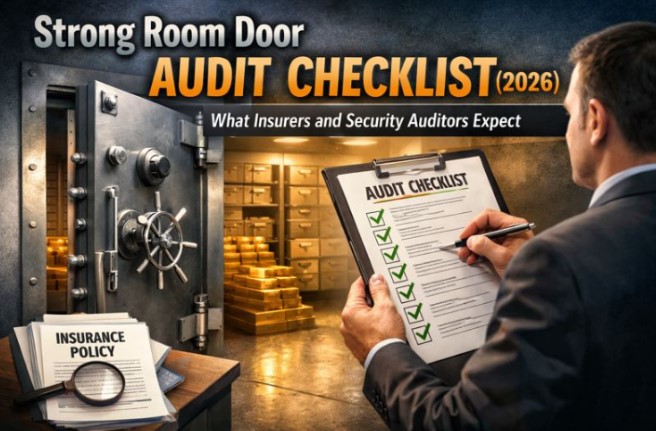
Strong Room Door Audit Checklist (2026): What Insurers and Security Auditors Expect
avansa
Insurer-ready 2026 checklist for strong room doors: standards, installation proof, access controls, monitoring, and maintenance records.
JOHANNESBURG, GAUTENG, SOUTH AFRICA, January 16, 2026 /EINPresswire.com/ -- As insurers tighten underwriting criteria and security audits become more evidence-driven, strong room doors are receiving increased scrutiny across retail, banking, logistics, and industrial environments.Businesses that store cash, valuables, firearms, sensitive records, or high-value stock are finding that a safe door is no longer assessed as a standalone product. Instead, auditors evaluate the door as part of a broader control system that includes certification, installation quality, and operational discipline.
Why this matters for businesses in 2026
A strong room or vault door is only considered effective when three elements align: a tested door, correct installation, and controlled daily use.
Many audit findings are not the result of attempted break-ins. Instead, they stem from incomplete documentation, unclear access controls, or inconsistent maintenance records. These can delay insurance approvals or trigger conditions and increased premiums.
“Most audit issues aren’t about dramatic forced entry,” says Donavan Herman, Security Specialist at Avansa. “They relate to missing paperwork, poorly defined access rules, or maintenance that only happens after a lockout. A strong room door is part hardware and part discipline, and auditors expect to see evidence of both.”
The standards and evidence auditors look for
Auditors and insurers generally assess whether a strong room door and its locking system have been tested to recognised standards, and whether the installed configuration matches what was certified.
Common standards referenced during reviews include:
EN 1143-1 – Burglary-resistance testing and grading for strong room doors and secure storage units
UL 608 – Burglary-resistant vault doors and modular panels, with attack-based ratings
CAT Rating (South Africa) – Indicates firearm resistance category
EN 1300 – Classification and requirements for high-security locks
*Not all insurers require the same standards or grades. What matters is the ability to demonstrate what is installed, what it is rated for, and that it is being operated and maintained in line with those ratings.
Strong room door audit checklist
These areas are commonly reviewed during insurance inspections and security audits.
1) Door identity and rating
Record make/model, serial number, and installation date
Keep test certifications matching the supplied door
Document lock type and relevant classification
Confirm labels/plates are legible and match records
2) Installation quality
File installer commissioning/handover documents
Confirm fixing, anchoring, grouting, and reinforcement meet specification
Check for movement, misalignment, hinge sag, or unusual bolt wear
Verify walls/floor/ceiling are at least as robust as the door
3) Locking and opening controls
Document opening method (key, mechanical, electronic)
For electronic locks, record time delay, dual control, and audit trail settings
Keep procedures for power/battery failure and lockouts
4) Access rules
Maintain an authorised access list (names/roles/approval dates)
Apply least-privilege access
Define visitor/contractor rules, including escort requirements
5) Keys, codes, and access knowledge
Maintain a key register (issue/return)
Document code policy (change frequency, leavers)
Avoid shared codes and record actions after suspected compromise
6) Entry logs and review
Export and retain electronic audit trails where available
Use manual access logs if electronic logging is not supported
Sample-check logs against CCTV or shift records
7) Monitoring and response
Confirm alarm coverage and test regularly
Ensure CCTV clearly covers the door and approach
Document response steps for tampering, forced-entry signs, or malfunctions
8) Maintenance and service records
Keep records of inspections, servicing, repairs, and parts replaced
Show maintenance is scheduled, not only reactive
Track recurring faults and corrective actions
Making audits easier through better preparation
Audit outcomes often depend more on preparation than hardware. Tested doors help, but documentation, access control, and maintenance records matter too.
A consolidated evidence pack — certifications, installation records, access policies, key/code registers, maintenance logs, and recent access history — typically speeds up audits and reduces follow-up queries.
Strong room doors are increasingly assessed on ongoing control and management, not only strength.
Donavan Herman
Avansa
+27 870953333
sales@avansa.co.za
Legal Disclaimer:
EIN Presswire provides this news content "as is" without warranty of any kind. We do not accept any responsibility or liability for the accuracy, content, images, videos, licenses, completeness, legality, or reliability of the information contained in this article. If you have any complaints or copyright issues related to this article, kindly contact the author above.
