

Belfast Animation Studio Expands E-Learning and Corporate Training Services Across UK
Belfast-based Educational Voice specialises in educational animations, explainer videos, and corporate training content for clients throughout the UK and Ireland.
Explore the Educational Voice blog for insights on 2D animation, explainer videos, and how businesses can use animated content effectively.
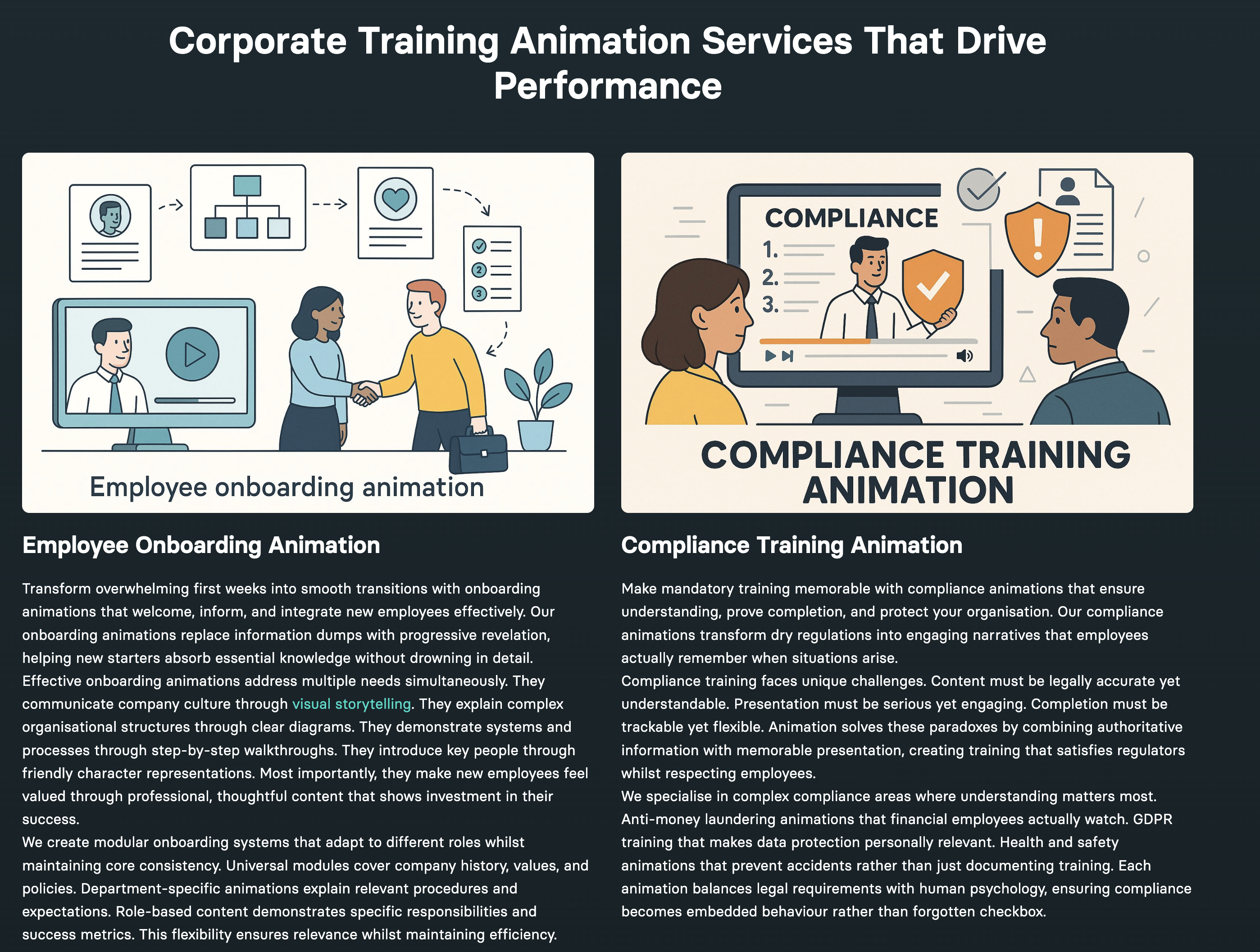
Animated training content from Educational Voice helps organisations deliver consistent, engaging instruction across their workforce.
From script development to post-production, Educational Voice offers a collaborative approach to creating animations that get results.
Educational Voice strengthens offering as more companies recognise animation's business impact - Belfast Northern Ireland
Educational Voice targets growing demand for animated training content as organisations shift toward video-based learning
Educational Voice targets growing demand for animated training content as organisations shift toward video-based learning
Educational Voice, the Belfast-based 2D animation studio, is expanding its e-learning and corporate training animation services to meet growing demand from UK businesses seeking engaging video-based learning solutions.
The studio, which has built its reputation producing thousands of educational animations for schools and learning platforms, is now actively working with businesses to create animated training content for employee onboarding, compliance, product knowledge, and skills development.
The expansion comes as UK organisations increasingly recognise that traditional training methods struggle to engage modern workforces. Industry research suggests the e-learning market could exceed USD 600 billion globally by 2029, with corporate training representing one of the fastest-growing segments.
Michelle Connolly, Founder of Educational Voice, said: "We've spent years perfecting how to explain complex ideas through animation for educational audiences. Those same principles apply directly to corporate training – clear messaging, visual storytelling, and content that actually holds attention. Businesses are realising that a well-produced training animation can reach thousands of employees consistently, at a fraction of the cost of traditional instructor-led sessions."
Why Businesses Are Turning to Animated Training
The shift toward animated e-learning content reflects broader changes in how people consume information and how organisations approach workforce development.
Engagement and Retention
Studies consistently show that video-based learning outperforms traditional formats. Research indicates that learners retain significantly more information when it's presented visually compared to text-based instruction. For time-pressed employees completing mandatory training, this difference translates directly into better outcomes.
Animated content captures attention in ways that static presentations and text-heavy manuals cannot. When employees actually watch and absorb training materials rather than clicking through to complete a requirement, organisations see genuine improvements in knowledge retention and application.
The challenge facing most organisations is not a lack of training content but a lack of engagement with existing materials. Employees report feeling disengaged from traditional training formats, viewing them as interruptions rather than valuable development opportunities. Animation addresses this directly by delivering information in a format that feels less like a chore and more like content worth watching.
Consistency at Scale
A single well-produced training animation delivers identical instruction to every employee, regardless of location, time zone, or trainer availability. For organisations with distributed workforces, multiple sites, or high staff turnover, this consistency is invaluable.
New employees in Belfast receive the same quality onboarding as those in London, Birmingham, or Edinburgh. Compliance training meets the same standard whether completed in January or July. Animation removes the variability inherent in instructor-led training while maintaining engagement.
This consistency matters particularly for regulated industries where training quality directly impacts compliance. When every employee receives identical instruction, organisations can demonstrate due diligence and maintain audit trails more effectively than with variable instructor-led approaches.
Cost-Effectiveness
While professional animation requires upfront investment, the economics favour video-based training for most organisations. A training animation can be viewed unlimited times by unlimited employees without additional cost. Updates can be made efficiently when procedures or regulations change.
Compared to repeated instructor-led sessions, travel costs, venue hire, and productivity lost to lengthy training days, animated e-learning often delivers substantial savings – particularly for content that needs to reach large or geographically dispersed teams.
The cost calculation shifts further in animation's favour when considering indirect benefits. Reduced training time means employees become productive faster. Consistent quality reduces errors and rework. Better engagement improves knowledge retention, reducing the need for refresher training. When these factors are included, the business case for animated training becomes compelling for organisations of all sizes.
Accessibility
Animated training content can be designed for accessibility from the outset. Closed captions support deaf and hard-of-hearing employees. Audio descriptions assist visually impaired staff. Adjustable playback speeds allow learners to process information at their own pace.
These features aren't just compliance requirements – they improve comprehension for all learners. Captions help employees watching in noisy environments. Slower playback benefits those processing complex technical information. Accessibility-first design creates better training for everyone.
Organisations with diverse workforces particularly benefit from animation's accessibility advantages. Visual storytelling transcends language barriers, making content more accessible to employees whose first language isn't English. Combined with translated captions or voiceovers, a single animation can serve multilingual teams without creating entirely separate training programmes.
The E-Learning Market Opportunity
The growth in e-learning represents one of the most significant shifts in how organisations develop their workforces. Understanding the scale and drivers of this change helps explain why animated training content has moved from nice-to-have to business essential.
Market Growth and Projections
The global e-learning market continues to expand rapidly. Industry analysts project growth rates exceeding 10% annually through the end of the decade, driven by technological advancement, changing workforce expectations, and demonstrated effectiveness compared to traditional training methods.
Corporate training represents a substantial portion of this growth. Organisations are investing more in workforce development while simultaneously demanding better returns on that investment. Animation's combination of engagement, scalability, and measurability aligns perfectly with these priorities.
The UK market specifically shows strong demand for quality e-learning content. Businesses recognise that competitive advantage increasingly depends on workforce capability, and that capability depends on effective training. Animation has emerged as the format best suited to delivering that training.
Driving Forces Behind the Shift
Several factors are accelerating the move toward animated e-learning content.
Remote and hybrid working has normalised video-based communication and learning. Employees who spend their days on video calls and consuming digital content expect training to meet similar standards. Text-heavy PDFs and static presentations feel outdated compared to the polished video content people consume elsewhere.
Generational shifts in the workforce play a role too. Younger employees have grown up with video as their primary information medium. They learn differently from previous generations and respond better to visual, engaging content than to traditional training formats.
Technology has made professional animation more accessible. What once required Hollywood budgets can now be produced affordably for business applications. This democratisation of animation quality means SMEs can access the same engaging training formats previously available only to large corporations.
Corporate Training Animation Applications
Educational Voice produces animated training content across a range of business applications, each tailored to specific learning objectives and audience needs.
Employee Onboarding
First impressions matter. Animated onboarding content introduces new employees to company culture, values, processes, and expectations in an engaging format that sets a positive tone from day one.
Rather than overwhelming new starters with dense employee handbooks or lengthy orientation presentations, animation delivers essential information in digestible segments. New employees can revisit content as needed, reinforcing learning during their crucial first weeks.
Effective onboarding animation covers the essentials without overloading. Company history and values, team structures, key processes, system access, and cultural expectations can all be conveyed through short, focused animations that new employees actually remember.
Compliance Training
Compliance training often suffers from a reputation problem – employees see it as a box-ticking exercise rather than genuinely valuable content. Animation transforms dry regulatory requirements into engaging explanations of why compliance matters and how to apply it in practice.
Health and safety, data protection, anti-bribery, equality and diversity, and sector-specific regulations all lend themselves to animated explanation. Visual scenarios demonstrate correct procedures and the consequences of non-compliance far more effectively than bullet-pointed policies.
The key to effective compliance animation is making the content feel relevant rather than abstract. Scenarios set in recognisable workplace situations help employees connect regulatory requirements to their daily responsibilities. When compliance training tells stories rather than lists rules, completion rates and comprehension both improve.
Product and Service Training
When employees understand products thoroughly, they sell more effectively and support customers better. Animated product training brings features and benefits to life, demonstrating functionality that would be difficult to convey through text or static images.
For complex products – technical equipment, software platforms, financial instruments – animation simplifies explanation while ensuring consistent messaging across sales, support, and operational teams.
Product training animation works particularly well for conveying how products solve customer problems. Rather than listing features, animation can show products in action, demonstrating value in ways that stick with employees and translate into better customer conversations.
Process and Procedure Training
Step-by-step procedures become intuitive when demonstrated visually. Animation shows rather than tells, guiding employees through workflows, system navigation, and operational processes in a format they can follow and revisit.
Manufacturing procedures, software workflows, customer service protocols, and administrative processes all benefit from animated demonstration. Employees see exactly what correct execution looks like rather than interpreting written instructions.
For safety-critical procedures, animation's precision matters enormously. There's no ambiguity about what correct practice looks like when it's demonstrated visually. This clarity reduces errors, improves safety, and builds employee confidence in following procedures correctly.
Skills Development
Soft skills training – communication, leadership, customer service, conflict resolution – gains impact through animated scenarios. Characters demonstrate effective and ineffective approaches, making abstract concepts concrete and memorable.
Animation creates safe spaces to explore challenging situations. Employees observe how scenarios unfold without the pressure of live role-play, building understanding before applying skills in real interactions.
Leadership development, management training, and customer service excellence all benefit from animated content that shows rather than tells. Abstract concepts like active listening, empathetic communication, and constructive feedback become tangible when demonstrated through character interactions.
The Educational Voice Approach to Corporate Training Animation
Educational Voice brings a distinctive approach to corporate training content, shaped by years of producing educational animations that genuinely engage learners.
Learning Objectives First
Every project begins with clarity about what employees should know or be able to do after completing the training. Vague briefs lead to unfocused content. Educational Voice works with clients to define specific, measurable learning outcomes before any creative work begins.
This discipline ensures every animation serves a clear purpose. Resources focus on content that drives genuine learning rather than impressive-looking material that fails to change behaviour or improve performance.
Audience Understanding
Effective training speaks to its audience. Content for factory floor workers differs from content for senior managers. Technical depth appropriate for specialists overwhelms generalists. Educational Voice develops training content with specific audiences in mind, matching tone, complexity, and examples to viewer needs.
Understanding the audience extends beyond job roles to learning contexts. Training watched on a phone during a commute needs different pacing than content viewed at a desk. Animation designed for group sessions differs from self-directed e-learning. These considerations shape every production decision.
Engaging Storytelling
Training content competes for attention with every other demand on employees' time. Educational Voice applies storytelling techniques that capture and maintain engagement – relatable characters, realistic scenarios, clear narrative structure, and visual interest throughout.
The goal is training that employees actually watch rather than content they minimise while doing other work. This requires treating corporate audiences with the same creative respect as any other viewers, producing content worth their attention.
Brand Alignment
Corporate training represents the organisation to its employees. Educational Voice creates content that reflects client brand identity, values, and culture. Colour palettes, visual style, tone of voice, and character design all align with broader brand guidelines.
Consistent branding across training materials reinforces organisational identity and professionalism. Employees experience training as an extension of the company rather than generic third-party content that feels disconnected from their workplace.
Measurable Impact
Training exists to change behaviour and improve performance. Educational Voice helps clients build assessment and feedback mechanisms into training programmes, enabling measurement of knowledge retention and application.
Effective measurement goes beyond completion rates to assess genuine learning. Knowledge checks, scenario-based assessments, and follow-up evaluation help organisations understand whether training investment delivers real returns.
Sectors Benefiting from Animated Training Content
While animated training applies across virtually every industry, certain sectors are seeing particularly strong adoption.
Healthcare
Healthcare organisations use animated training for clinical procedures, equipment operation, infection control, patient communication, and regulatory compliance. Animation's ability to visualise internal body processes and demonstrate correct technique makes it invaluable for medical training.
Patient safety depends on consistent, effective training. Animation delivers that consistency while engaging healthcare professionals who have limited time for training alongside demanding clinical responsibilities.
Financial Services
Banks, insurers, and financial advisers face complex regulatory requirements and need staff who can explain sophisticated products clearly. Animated compliance training and product education help financial services firms maintain standards while improving customer outcomes.
The combination of regulatory pressure and product complexity makes animation particularly valuable in financial services. Visual explanation of concepts like compound interest, risk assessment, or pension calculations helps employees communicate more effectively with customers.
Manufacturing and Logistics
Safety-critical environments benefit enormously from animated procedure training. Visual demonstration of correct equipment operation, safety protocols, and quality control processes reduces accidents and improves operational consistency.
In manufacturing contexts, training quality directly impacts safety outcomes. Animation's ability to show correct procedures precisely, and to demonstrate the consequences of incorrect practice, makes it a valuable tool for maintaining safe operations.
Technology
Software companies and tech-enabled businesses use animation for product training, system onboarding, and technical skill development. Complex digital processes become accessible when demonstrated visually rather than described textually.
For technology businesses, animation also serves customer education purposes. Training customers to use products effectively reduces support burden while improving satisfaction and retention.
Retail and Hospitality
High-turnover sectors need efficient onboarding that gets new staff productive quickly. Animated training delivers consistent brand standards, customer service expectations, and operational procedures across distributed teams.
When staff turnover is high, training efficiency matters enormously. Animation's ability to deliver consistent, engaging onboarding at scale helps retail and hospitality businesses maintain service standards despite workforce churn.
Professional Services
Law firms, consultancies, and accountancy practices use animated training for compliance, client service standards, and professional development. Animation adds engagement to content that might otherwise feel dry or procedural.
Professional services firms increasingly recognise that client service excellence depends on consistent training across their teams. Animation helps deliver that consistency while respecting professionals' time constraints.
Getting Started with Corporate Training Animation
Organisations considering animated training content should begin by identifying where current training falls short. High failure rates on compliance assessments, inconsistent customer service quality, lengthy onboarding periods, and poor engagement with existing training materials all signal opportunities for improvement.
The most effective approach starts with a specific, contained project rather than attempting to animate an entire training catalogue at once. A single compliance module, an onboarding sequence, or a product training piece allows organisations to experience the production process and measure results before committing to larger programmes.
Educational Voice offers initial consultations to help businesses identify where animation can deliver the greatest impact and develop content strategies aligned with training objectives and budgets.
"The organisations getting the best results from animated training are those who see it as an investment in their workforce rather than just a cost to manage," said Connolly. "When training genuinely engages employees and improves performance, the return on investment speaks for itself."
Michelle Connolly
Educational Voice
+44 28 9592 1656
email us here
Visit us on social media:
Facebook
YouTube
X
Other
How does it work?
Legal Disclaimer:
EIN Presswire provides this news content "as is" without warranty of any kind. We do not accept any responsibility or liability for the accuracy, content, images, videos, licenses, completeness, legality, or reliability of the information contained in this article. If you have any complaints or copyright issues related to this article, kindly contact the author above.
